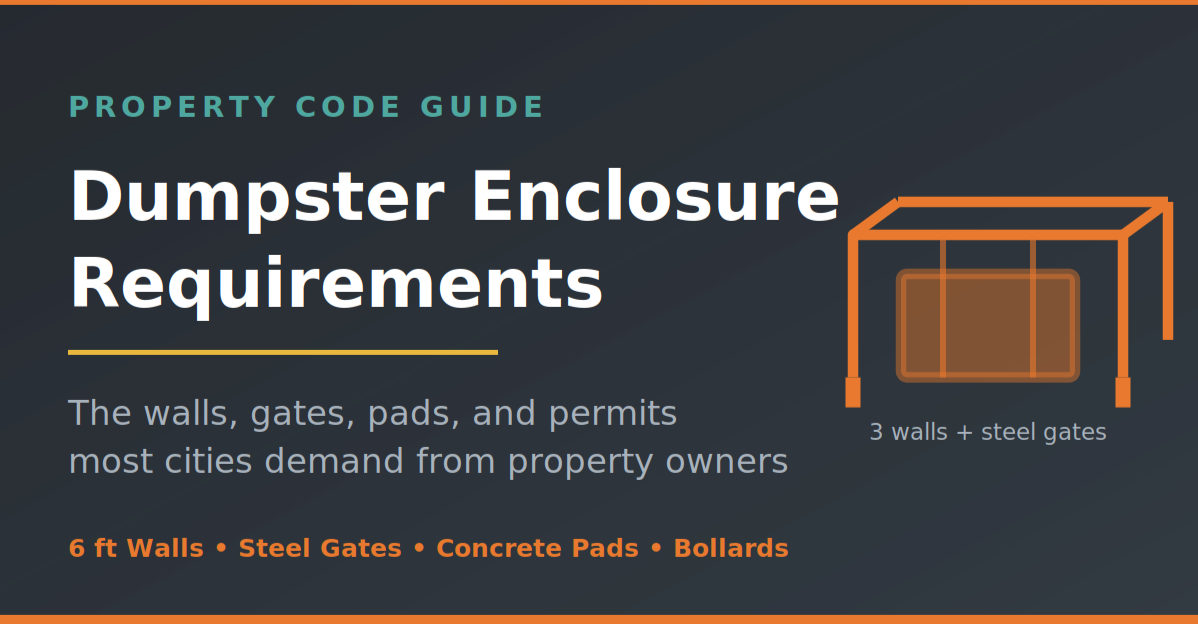
If your commercial or multi-family property has a dumpster, your city almost certainly has rules about hiding it. Most municipalities now require a full dumpster enclosure: screening walls, gates, a concrete pad, and a permit before you build any of it.
The details vary by city, but the pattern repeats everywhere. This guide walks through the requirements you will meet in almost every code book, so you can build the enclosure once and pass inspection the first time.
Why Cities Require Dumpster Enclosures
The reasons are practical. Open dumpsters attract illegal dumping, scavenging, and pests. Wind pulls loose trash across parking lots and into storm drains. And nothing drags down a streetscape faster than a rusting container in full view.
Cities responded by writing enclosures into their zoning and solid waste codes, usually for all commercial properties and multi-family buildings above a small unit count. The logic mirrors what real estate professionals already know: visible trash kills property appeal, which is exactly why junk removal plays such a big role in home staging before a sale.
The Wall Requirements
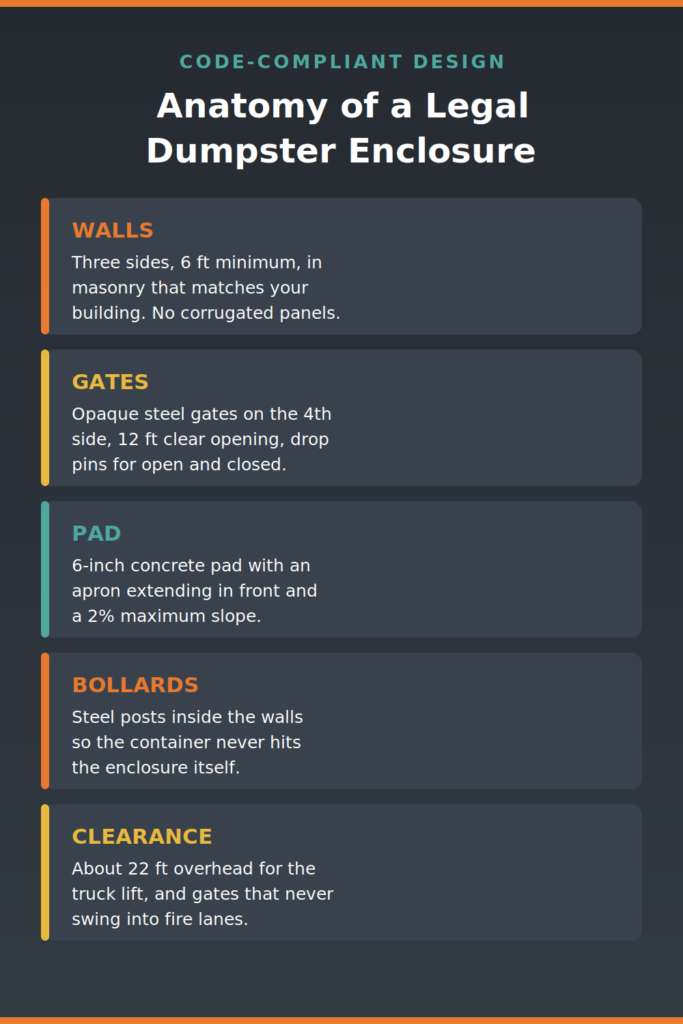
Nearly every code starts the same way: the dumpster must be screened on three sides by a solid wall, with the fourth side closed by gates. The standard minimum height is six feet, and many cities instead require the wall to rise at least six to twelve inches above the tallest part of the container, whichever is higher.
Materials matter just as much as height. Where the enclosure is visible from a public street, most cities demand masonry, brick, stone, or reinforced concrete that matches the main building in material and color. The city of Hollywood, Florida spells out a typical rule set: opaque gates, a hardened paving surface, height above the container, and a building permit before construction begins. Corrugated sheet metal and fiberglass panels are commonly banned outright.
Alt text: Anatomy of a code compliant dumpster enclosure infographic
The Gate Requirements
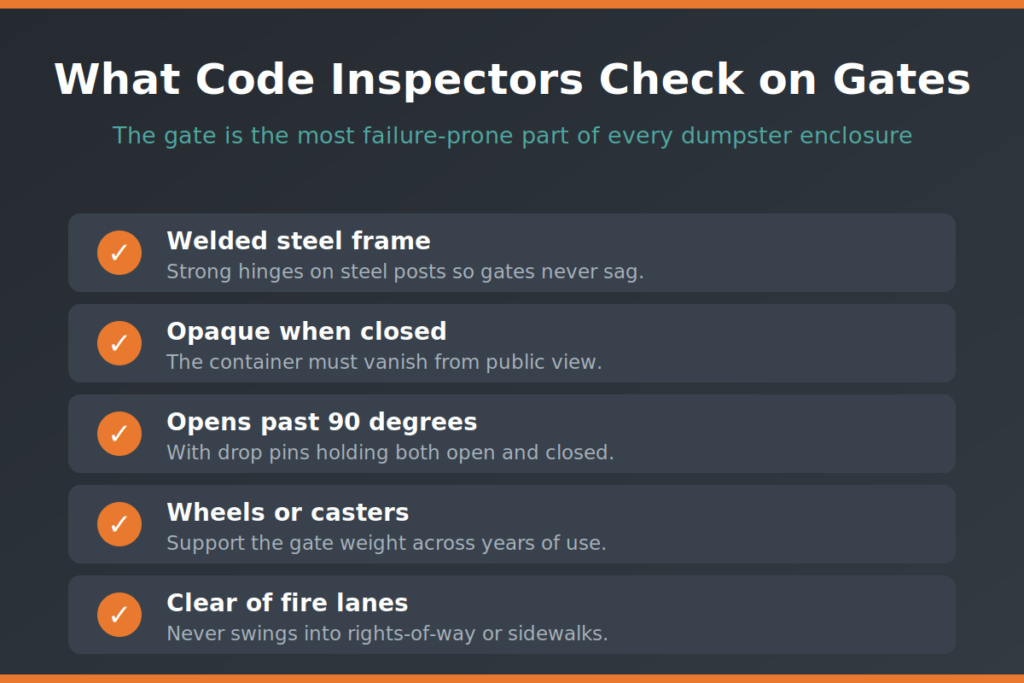
Gates carry the strictest rules in the whole enclosure, because they are the part that fails. They swing thousands of times, take hits from containers and trucks, and sag the moment the hardware is undersized. Codes typically demand solid, opaque gates that fully hide the container, a clear opening around 12 feet wide for the collection truck, swings past 90 degrees, and drop pins that hold the gates in both the open and closed positions.
Wood-on-wood construction rarely survives those demands, which is why property managers upgrade to commercial dumpster gates built on welded steel frames, hung from heavy-duty hinges on steel posts, and fitted with wheels and drop rods that keep them square through years of daily service. A steel frame can still carry cedar or composite infill, so the gates match the building while the structure underneath stays rigid.
Alt text: What code inspectors check on dumpster enclosure gates
Two placement rules trip up many owners: gates may never swing into a fire lane, sidewalk, or public right-of-way, and most codes require the gates to stay closed at all times except during collection. Some cities even require a posted sign saying exactly that.
The Pad, Bollards, and Clearances
Under the enclosure, codes require a concrete pad, commonly six inches thick, sized larger than the container and extending forward as an apron where the truck’s front wheels land during pickup. Slopes stay gentle, usually two percent or less, so the container rolls safely and stormwater drains away.
Inside the walls, steel bollards or curb bumpers protect the masonry from the container itself. Above, plan for roughly 22 feet of overhead clearance so the truck can lift and empty the container, a figure highlighted in Lee County’s enclosure design standards along with a 12-foot minimum gate opening. Many codes also require a 36-inch pedestrian opening so staff can reach the container without swinging the main gates.
Getting Your Enclosure Approved
Almost every city treats an enclosure as a permitted structure. Expect to submit a site plan showing the enclosure location, setbacks from property lines, and the gate swing path, plus construction details for the walls, pad, and gates. Enclosures near residential lots usually face extra setback rules.
Build the approval into your project timeline rather than treating it as an afterthought. A compliant, well-finished enclosure reads as pride of ownership from the street, and it pays back the same way regular lawn care raises property value: buyers, tenants, and inspectors all notice the properties that sweat the details.
One last tip: involve your waste hauler before you pour concrete. They know the truck sizes, approach angles, and clearances for your exact route, and a five-minute call beats rebuilding a wall.
FAQs
How tall does a dumpster enclosure have to be?
Most cities require a minimum of six feet, or a wall that rises at least 6 to 12 inches above the tallest part of the container, whichever is greater.
Compactor enclosures often need eight feet. Check your local code for the exact figure.
What materials are required for enclosure walls?
Walls visible from a public street usually must be masonry, brick, stone, or reinforced concrete that matches the main building. Corrugated metal and fiberglass panels are widely prohibited.
Enclosures hidden from the street often get more flexibility, including wood or painted metal.
What are the requirements for dumpster enclosure gates?
Typical rules: opaque gates that fully screen the container, a 12-foot clear opening, swings beyond 90 degrees, drop pins for the open and closed positions, and no swinging into fire lanes or rights-of-way.
Steel-framed gates with wheels or heavy hinges meet these rules far longer than all-wood construction.
Do I need a permit to build a dumpster enclosure?
Almost always, yes. Cities treat enclosures as structures, so expect a building permit, a site plan showing setbacks and gate swing, and an inspection.
Large new concrete areas can trigger additional county or stormwater review in some regions.
How big should the concrete pad be?
Plan on a pad roughly six inches thick, extending beyond the container on all sides, with an apron reaching several feet in front of the gates where the truck loads.
Keep the slope at two percent or less so the container rolls safely and water drains away from the enclosure.