
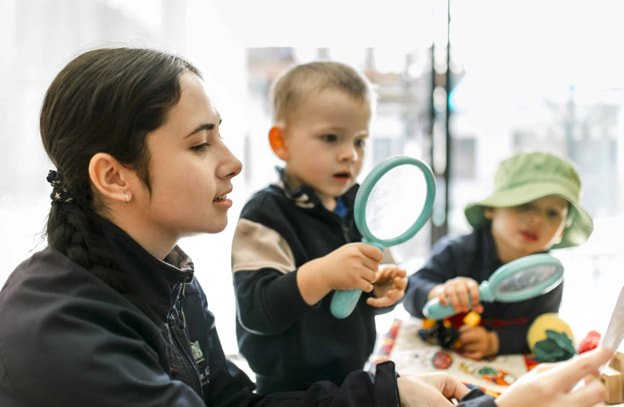
Early childhood experiences can influence children in the way that they think about learning, relationships, routine and when something is different later. With an early learning centre in Ipswich, families can have early learning care that is focused on discovery, care, and development. A considered environment makes room for discussion, activity, imagination, invention, solving problems and a sense of community. A sense of security leads to children being willing to investigate, explore, ask questions and begin to become independent.
Curious Thinking
Children explore the world by touching and testing, asking questions, watching and trying again. A good learning area keeps fostering that curiosity rather than sentiments to speed children up to a predetermined solution. Teachers can make simple interests come alive by using stories, experiments, outdoor observation projects, construction and imaginative play. The learning in an early learning centre in Ipswich is not ordinary – it can happen when it least expected. Questions can expand to become a discussion which continues afterward, capturing kids’ attention longer than the initial question.
Social Confidence
Socializing with peers gives children chances to learn things that are not always found at home. Friends are made when children negotiate, laugh, disagree, play games together and then agree on a solution. These moments help children recognise their feelings, respect limits and see other people’s points of view. In a learning centre, in Ipswich caring guidance turns every interaction into a social learning moment. Children feel more confident when they join groups willingly ask for help take turns and solve problems.
Creative Expression
Children are provided with multiple avenues for communication through art, music, movement, building and pretend play. Creative experiences are important due to the fact that there’s seldom any single correct approach to arrive at. A cardboard box can be a shop, spaceship, cubby, stage, etc. – depends on imagination. This freedom can be fostered by teachers providing open-ended materials and letting go of certain choices. Using creative exploration, children learn to be persistent, coordinated, flexible and self-expressive, and may find a new interest that they would not have considered previously.
Practical Independence
When young children are trusted to undertake tasks that are appropriate for them, they feel confident. Materials are packed away, activities are selected, items are picked up and/or space is set up, which promotes participation. These jobs look mundane but help children to see that what they can do produces results. Supportive educators stay very close by and give children space to make their own attempts. Successful success creates self-reliance, patience and an ability to try something new without the need for an immediate reaction.
Outdoor Discovery
There is learning to be found outdoors, as it is a space of constant change with movement, weather, texture etc. Doing any of these things: running off, balancing, digging, climbing, collecting leaves or watching creatures is physical together with curiosity. When it’s time to get out of doors, however, there are times for quiet moments when children become aware of sounds, patterns and seasonal changes. These activities develop co-ordination skills, whilst also offering good conversation and imaginary play opportunities. When the outdoor setting is well designed, children can explore and have opportunities to find out more while feeling secure, included and supported during the process.
Family Partnership
When families and educators share something regarding communication in a transparent manner, kids typically feel at ease. Discussions on routines, interests, changes and new skills enrich the understanding of the child. Families can learn things that are of interest to him or her during the day and the educators can get some insights from home experiences. This partnership is designed to ensure continuity as opposed to the care and home lives being segregated. Communication that is respectful and practical improves the consistency of support for children and means families are involved in their children’s learning.
Conclusion
A good early learning centre in Ipswich can give children a solid foundation to build their characteristics of the early years; a sense of curiosity, a sense of communication, a sense of confidence and a sense of independence. The best moments can happen at any time and because they are that way they are the most valuable. Conversations turn to language and practice, disagreements turn to social learning, and outdoor play turns to discovery. If educators are establishing relationships of safety and families are engaged, children can freely experiment. The blend of that supports early learning to be active, fun and relevant, ensuring children have the right attitudes and learning skills to carry them forward for further learning.

